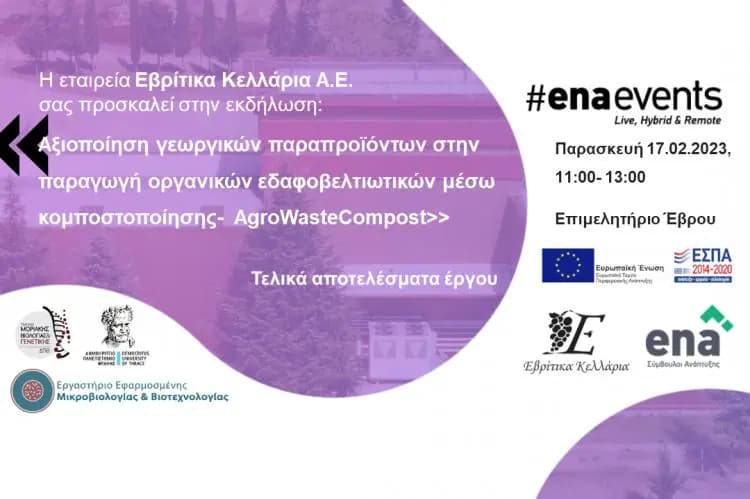
“Evritika Kellaria SA” invites you to the event titled “Using agricultural by-products to produce organic soil improvers through composting – AgroWasteCompost (Final project results)”.
The event will take place on Friday, February 17 at 11:00 a.m. in the Event Hall on the 3rd floor of the Evros Chamber of Commerce in Alexandroupoli.
The event is organized by ena Development Consultants through its #enaevents service, which designs and delivers educational, conference and informational events, in person, hybrid and remote, in the physical and digital world.
Event program
The program of the event “Using agricultural by-products to produce organic soil improvers through composting – AgroWasteCompost (Final project results)”.
11.00–11.15 | Arrival – Welcome
11.15–11.30 | “EVRITIKA KELLARIA S.A.” – Our story so far and a look to the future, Vasilis Charovas, CEO, “EVRITIKA KELLARIA S.A.”
11.30–11.45 | Current Challenges and Financing Tools for the Growth of the Agri-food Sector, Dimitris Bardakidis, General Manager & Head of Primary Sector Development Strategy, ena Development Consultants
11.45–11.50 | Short presentation of the Laboratory of Applied Microbiology & Biotechnology, Department of Molecular Biology & Genetics, DUTh, Ioannis Kourkoutas, Professor, DUTh
11.50–12.00 | Short description of the “AgroWasteCompost” project, Ioannis Kourkoutas, Professor, DUTh
12.00–12.30 | Short presentation of the final research results of the “AgroWasteCompost” project, Ioanna Karapantzou, Molecular Biologist, MSc, PhD Candidate, Department of Molecular Biology & Genetics, DUTh
12.30–13.00 | Final Conclusions – Discussion
You can find more information about the event and the program here.
The project
The disposal and management of agricultural waste and food industry by-products is a major problem worldwide today. Under recent European Union directives, agricultural waste may no longer be burned in the field or taken to uncontrolled dumps or unlicensed landfill, disposal or waste treatment sites, as these sites may become a source of environmental pollution. There is also a significant risk of toxic substances passing through the food chain to humans and living organisms.
One of the most economical and environmentally friendly solutions to this problem is composting. Composting is the biological decomposition and stabilization of organic materials, either through microbial activity or through the metabolic activity of specific organisms (earthworms), resulting in a stable, odorless product that can be used as a soil improver (organic fertilizer). A characteristic of the process is its low operating and investment cost compared with other technologies.
Accordingly, the goal of the investment plan is the development of innovative technologies for using agricultural by-products (plant biomass) from wineries to produce high value-added soil improvers (organic fertilizer).
The project will test (a) microbial composting, (b) vermicomposting (Eisenia fetida or Eisenia andrei), and (c) a combination of microbial composting and vermicomposting, applying the optimal conditions determined beforehand. During composting, and at regular intervals, key system parameters will be measured (productivity, temperature, pH, conductivity, oxygen concentration and moisture), along with the chemical composition of the products (the C/N ratio and the levels of P, K, Fe, Mn, Cu and Zn), the activity of enzymes related to the metabolic activity of the microbial population (dehydrogenase) and to earthworm activity (dehydrogenase, β-glucosidase, acid phosphatase and urease), and the microbial load (total mesophilic flora, yeasts/molds, enterobacteria, coliforms, Escherichia coli, clostridia, lactic acid bacteria and Salmonella spp.), which will also be confirmed with molecular methods (PCR-DGGE and/or Next Generation Sequencing, NGS). The next step is to evaluate the effectiveness and suitability of the compost products (proof-of-concept study) by examining the germination of barley seeds after soaking in an aqueous extract of the compost product, while the compost products will also be evaluated in vine growth, measuring shoot growth and leaf dry weight.
The final stage of the project is a feasibility study, which will above all include the technological validation of the technology developed and will define its target market.
In collaboration with the Subcontractor “Laboratory of Applied Microbiology & Biotechnology” of the Department of Molecular Biology & Genetics of Democritus University of Thrace.